
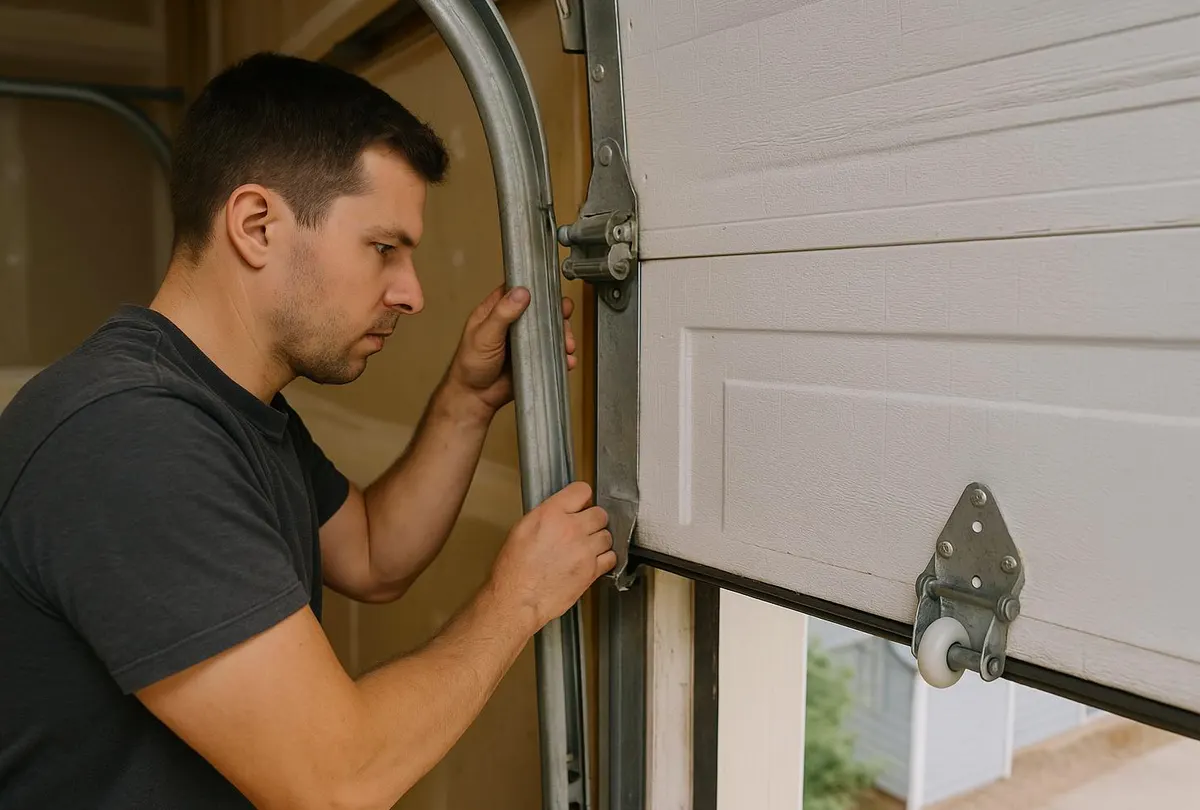
A bent or misaligned track makes the garage door run crooked, scrape against the rollers, or bind partway through its cycle instead of gliding smoothly. The fix depends on how bad the bend is and what caused it—sometimes it's a ten-minute adjustment, sometimes the track section needs to come out. Here's what to look for and how a technician works through the problem.
Signs the Tracks Are the Problem
- The door scrapes or squeals against one side as it moves, especially near the bottom few feet of track.
- One side of the door rises faster than the other, so the door looks tilted instead of level while it's moving.
- You can see daylight or a gap between a roller and the track it's supposed to sit inside.
- The door stops or hesitates partway through opening or closing, then jerks forward.
- A roller has popped out of the track entirely, or the track visibly bows away from the wall when you look down its length.
- The opener reverses unexpectedly because the door is dragging and the opener reads it as an obstruction.
Any one of these on its own might be something minor. A couple of them together almost always point to a track that's no longer straight or no longer anchored where it should be.
What Causes It, in the Order a Technician Checks
1. Impact Damage
This is the first thing to rule out because it's the most common and the easiest to spot. A bumper tap, a ladder, a snow blower, or a kid's bike leaning against the track can put a visible kink in the metal, almost always in the bottom three to four feet where things actually bump into it. A technician will run a hand and eye down that section looking for a dent or a spot where the track doesn't sit flush anymore.
2. Loose or Shifted Brackets and Fasteners
Tracks are bolted to the door frame with brackets, and those fasteners work loose over time from the door's vibration every time it opens and closes. Ashtabula's temperature swings make this worse—metal expands in humid summer heat and contracts in a hard winter freeze, and that constant movement gradually loosens hardware that was torqued down tight at installation. A loose bracket lets the track flex sideways under load, which is why a door can run fine for months and then suddenly start binding.
3. Settling or Shifting of the Door Frame
On older homes, or homes where the slab has shifted slightly, the wood jamb the track is mounted to can move out of plumb over years. Freeze-thaw cycles under the slab contribute to this locally. The track itself might be straight, but if it's bolted to a frame that's no longer square, the whole system is effectively misaligned. This is checked with a level against the track and against the frame separately, to see which one has actually moved.
4. Worn or Damaged Rollers
Rollers that are cracked, flat-spotted, or missing bearings don't roll—they grind. That grinding puts uneven side-load on the track every cycle, and over months it can pull the track slightly out of its original plane, especially near the curved section at the top where the load is highest. A technician will spin each roller by hand to check for roughness or play before blaming the track itself.
5. Original Installation Error
Less common, but worth ruling out on a door that's never run quite right since day one. If the track wasn't set plumb and level during installation, it will show stress and wear in a predictable pattern—usually the same spot on every cycle rather than a spot tied to a specific impact or a loose bracket.
How Each Fix Actually Works
For a loose or shifted bracket, the fix is straightforward: re-level the track with a level and a mallet, then retighten or replace the fasteners holding it to the frame. This is often a same-visit repair.
For a minor impact dent, a technician may be able to work the metal back into shape with the right tool if the bend is shallow and the track material allows it. Deeper dents usually mean replacing that section of track rather than risking a repair that fails again in a few months.
For frame settling, the fix involves re-anchoring the track to solid, plumb framing—sometimes adding a shim or a new mounting point rather than just retightening the original bolts.
For a severely bent track, full replacement of that side is the honest answer. Many technicians will recommend replacing both tracks together even if only one is damaged, since the other side has usually absorbed a similar amount of wear and will show problems soon after.
Whatever the cause, a thorough fix doesn't stop at the track. Rollers get checked and replaced if they're contributing to the problem, and the door's balance is tested afterward, since a door that's been running crooked for a while often puts extra strain on the springs and cables too.
When to Call Ashtabula Garage Door
If your door is scraping, running crooked, or has a roller out of the track, that's a job for a technician rather than a DIY fix—tracks carry real load, and working near them while the door is under spring tension isn't something to guess at. Ashtabula Garage Door handles this as part of standard garage door repair, and if the issue traces back to worn rollers or hardware that's reaching the end of its life, we'll flag it during garage door maintenance so it doesn't turn into a bigger repair next season.
If your garage door in Ashtabula, Geneva, Conneaut, or anywhere nearby is hanging crooked or scraping on its way up, give Ashtabula Garage Door a call and we'll get it running straight again.